Showing posts with label antenna modeling. Show all posts

Tuesday, September 17, 2013

Behold the awesomeness that is to be my 160m dipole...

This is a paraphrase/enhancement of a cross-post that I made to Reddit.  I'm putting up a ladder-line fed 160m dipole in the near future.  I forgot the insulators when taking the picture...


I should be able to get it up to around 60' in the trees that I have available. It won't be perfectly straight so it will favor the southeast a bit (watch out Caribbean, I'm coming for you!), but it should be better than what I have right now. Here is the planned layout as of right now.


After working it out in EZNEC it doesn't look as if the slight jog will throw off the pattern that much. It's still basically an NVIS antenna at the design frequency. Or to say it another way, I don't have any 260' trees to make it act like it would at a half-wave up.


At 1.8MHz it is definitely an NVIS antenna:
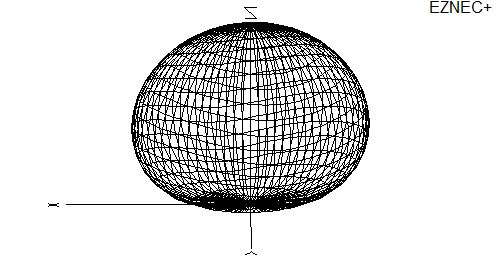


At 3.8MHz it is starting to look a little better, but kinda looks like a tumor (this is the favoring of the SE that I mentioned above):


At 7.2MHz it is starting to look more like a traditional dipole over real ground:

Once you get up to 14.2MHz you start seeing some weirdness:


To be honest, the main goal is for this to be a multiband doublet that just happens to be cut for 160m. I'm okay with NVIS on 160 for now. If I really start getting into it I might try an inverted-L or a vertical at some point in the future.  Several Redditors made that suggestion.

Total cost of the antenna is:

$47 for the wire at Home Depot
$50 for the spreaders and center support
$24 for the dacron rope at tractor supply
$06 for the insulators
$127 total

And I have enough wire left for a 40m end fed half wave for my Rockmite-40 with enough rope for hanging that as well. So I guess it was basically $127 for two antennas (plus the xformer parts for the efhw).  Not too shabby as one comment that I got so eloquently put it!  ;-)

73,

Richard, KK4JDO

Sunday, May 12, 2013

EZNEC Antenna modeling software

Hi All,

I have come to really appreciate that antenna modeling software called EZNEC.  It is a great front-end for NEC and is fairly simple to learn and understand.  However, this post isn't about reviewing the software, I think that it speaks for itself.  The one downside to EZNEC is that the Pro version is really expensive for an individual to purchase, but that is the version that has handy features like a tool for creating grids, which are necessary if you want to model a flat surface.

Being essentially a fairly cheap person, I decided to write a PERL script to do this instead of ponying up for the Pro version (I did purchase the Plus version at $139 though).  Since the ham radio community is a great group of folks (excepting a small few, I may post about that in the future), I wanted to give a little something back.  So, if you need to create a grid and don't want to do it manually, here you go!

This software is still a little bit of a work in progress, so expect some updates to this, but it is pretty well ready to go at this point.  Future additions will include the ability to model a hemisphere and a parabola for modeling dish antennas.

So without further adieu, here is the form.  Just click "Submit" after filling it in and you will get back a block of text that can be copied and pasted into a text document for import into EZNEC.  Detailed instructions on the import procedure are beyond the scope of this post, but they are easily accessible in the software itself which has an awesome help file system.


I hope that you can make use of this! I enjoyed scripting it and hope to be able to continue to update it. Please leave a comment if you like it our would like to suggest improvements or request features.

Once imported, the grid will look something like this, depending on the options that you chose.


One side note, I am a network engineer by trade, not a programmer or web designer.  I use PERL for my job, but an not elegant.  I tend to be a brute force developer.  The code is ugly, but it works, which is usually what happens to PERL scripts over time, I just start out that way and save all the intervening effort.  ;-)

Thanks and 73,

Richard, KK4JDO